MathsArt Competition 2022
Some of our Year 7-12 students are currently busy working on their entries for the local MathsArt Competition 2022 run by the GMMDC (Govan Mbeki Maths Development Centre Nelson Mandela University). The theme for this year is: “Mathematics: the language of the sciences”. This serves to link Art, Maths and Science (STEAM subjects) to address the question: “What do you get when you add MATHS and ART and the THEME and mix them up to the power of your CREATIVITY”?
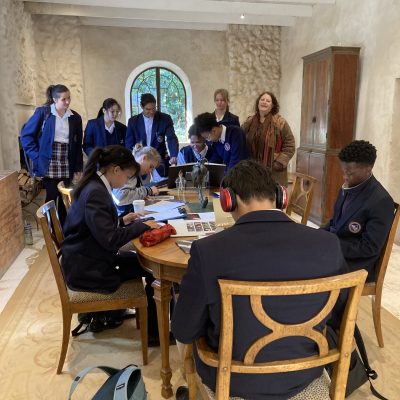
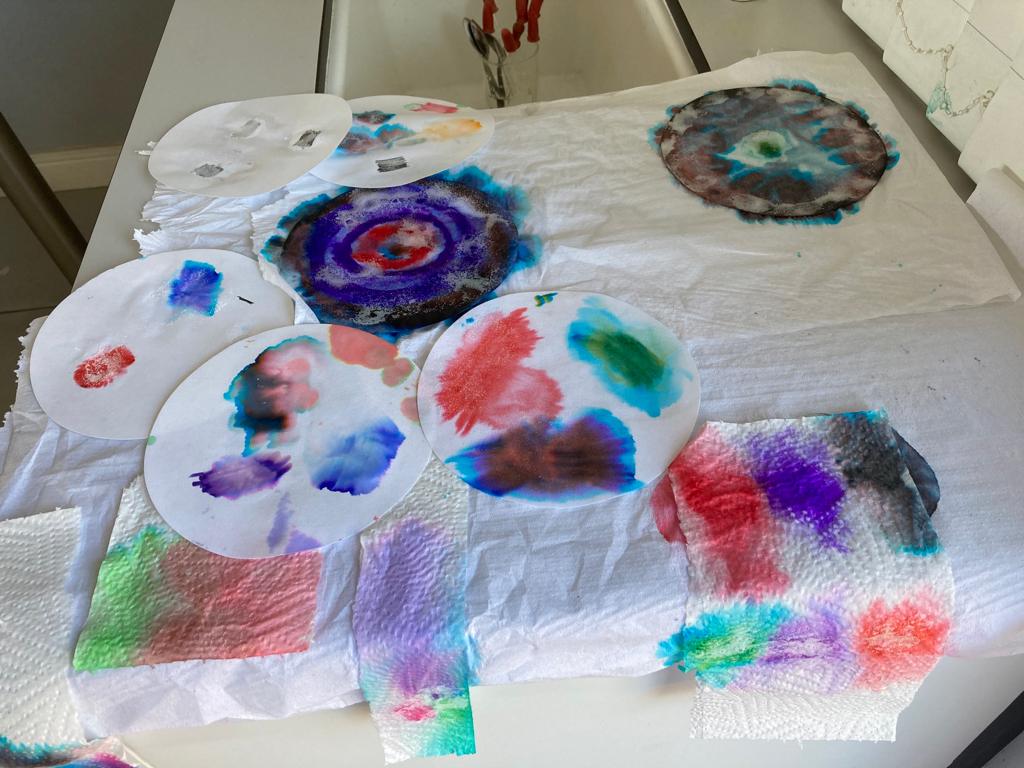
On the last day of Term 1, our Year 9 students together with their Sciences and Art & Design teachers explored some fun colour experiments to connect Art and Science by a series of simple paper chromatography experiments by looking at the components of black and coloured koki pens using: paper towel and/or filter paper and/or coffee filter paper, black and coloured kokis, plus different marker pens (permanent/non-permanent), water or vinegar and bicarbonate of soda, glass or tile bases, and pipettes.
In the first experiment black and coloured koki lines or designs were drawn on the paper towel, filter paper and coffee filter paper, with pipetted water droplets applied to the various papers so that the black and colours could diffuse. This resulted in students observing that black ink is simply not black but, along with the other colours, could separate into a rainbow of colours of differing lengths.
The same method was applied with the second experiment, however, bicarbonate of soda was sprinkled onto the black lines and coloured designs which resulted in a ‘fizzy’ chemical reaction when the vinegar was pipetted onto the bicarbonate of soda allowing colour mixing to occur.
So what really happened? Marker inks are made from many different coloured dyes. (This being the most obvious with dark colours like black and purple.) Each dye is made up of different chemicals, some heavier and some lighter, that travel at different speeds as the water moves them up the paper. Heavier dyes will separate out first and move more slowly whilst the lighter dyes move faster up the paper, creating a tie-dyed or washed-out effect. It is interesting to try and count how many different colours one can observe in the final product. The same activity can also be tried using Sharpies or other permanent pens and isopropyl alcohol instead of water. What happens? The water-based markers are water-soluble and can diffuse in water. The permanent markers are not water-soluble but are only alcohol soluble. The markers react and diffuse when vinegar is dropped onto bicarbonate of soda.
By performing this experiment the learners taking mathematics and Science observed the physical (cognitive) link between science and art and the art learners witnessed the link to Science. Mathematics and Science are subjects in which creativity is essential for problem solving, summarising and retaining theory and seeing the bigger picture.
This local MathsArt Competition is an amazing opportunity to bridge the gap between Art and Science and we look forward to more learners from the Science discipline participating next year! Thank you, Mrs Leibbrandt, for the opportunity!
Ms Amelia Burger and Mrs Lynda Leibbrandt