A day in the High School
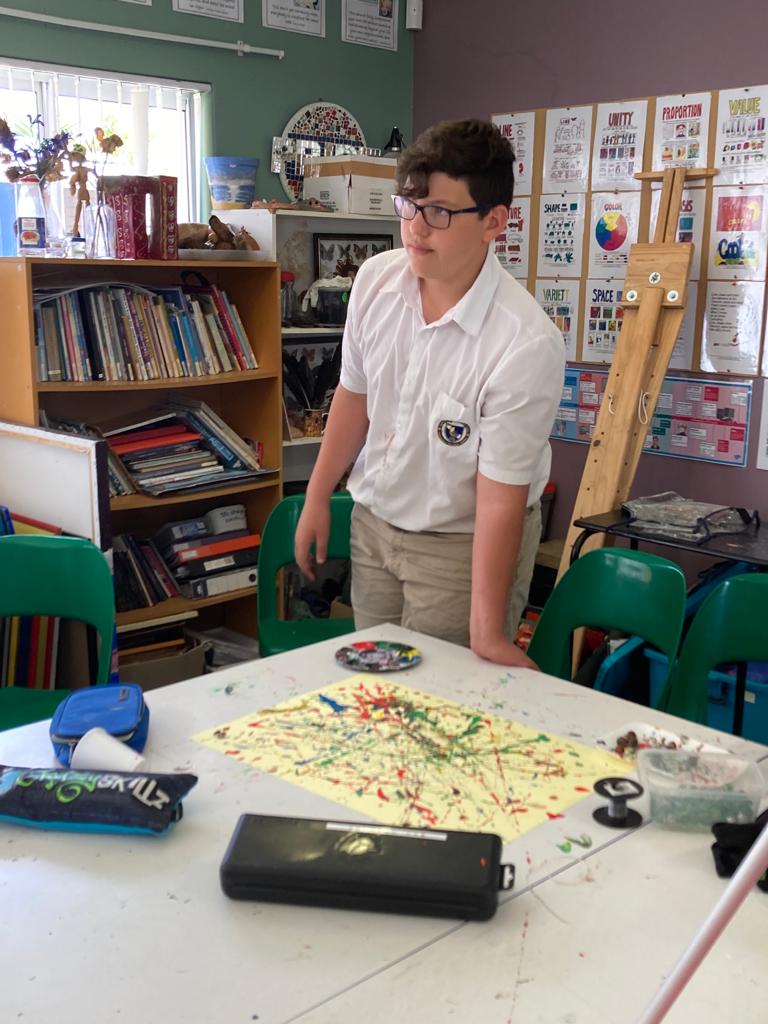
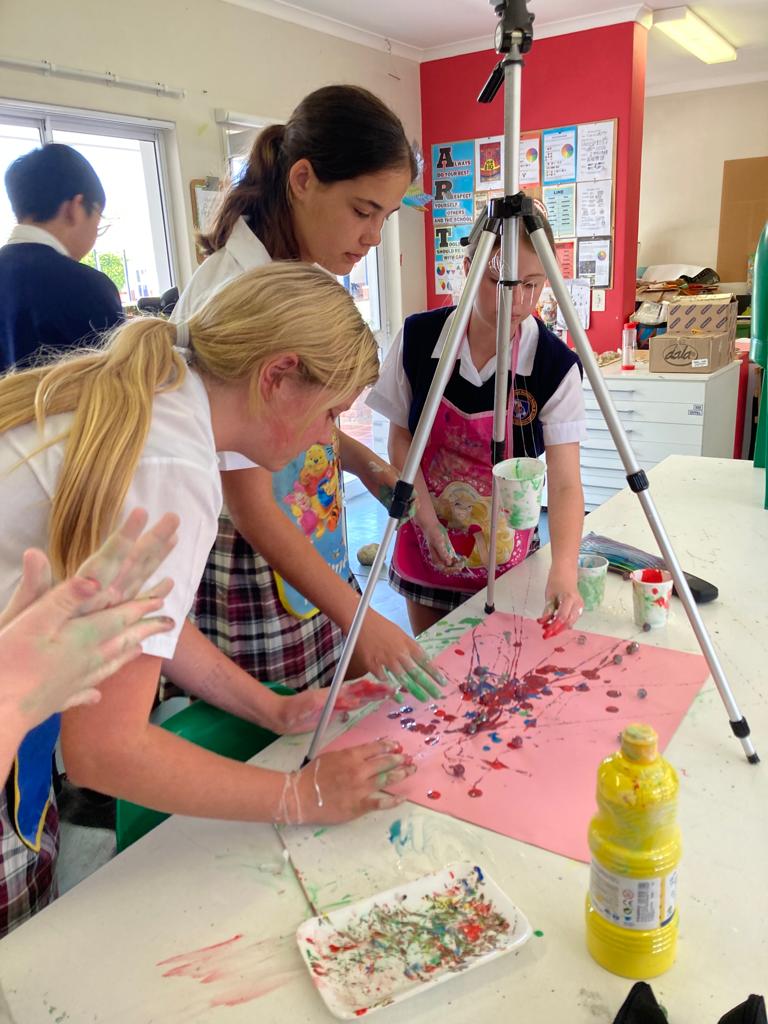
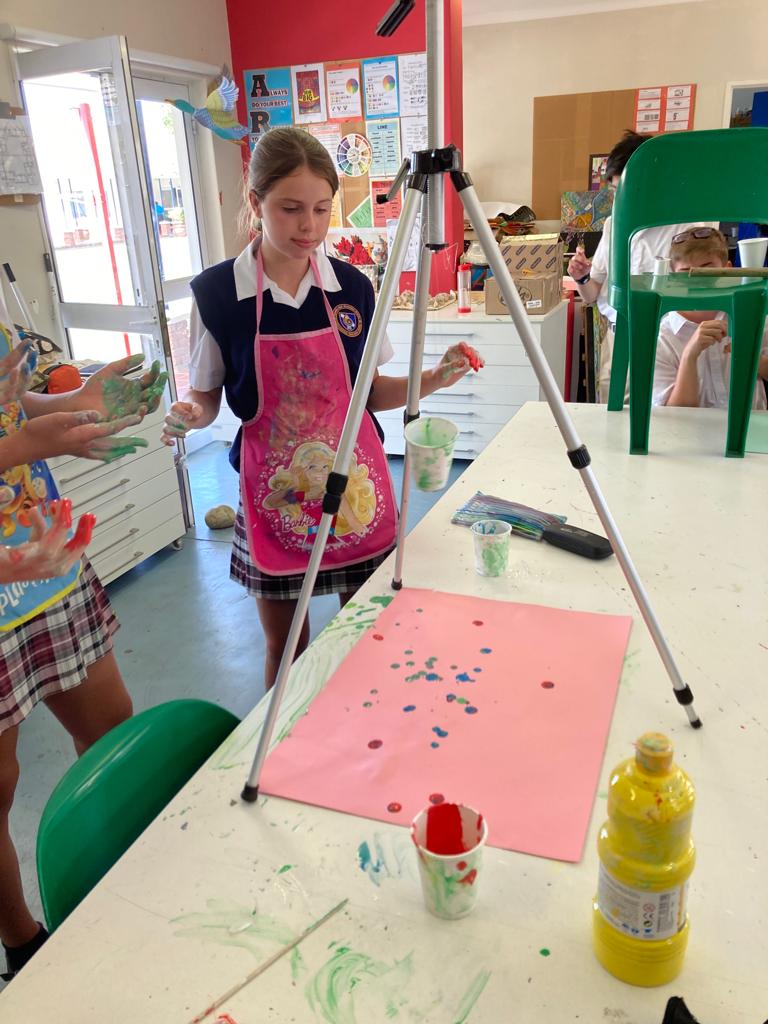
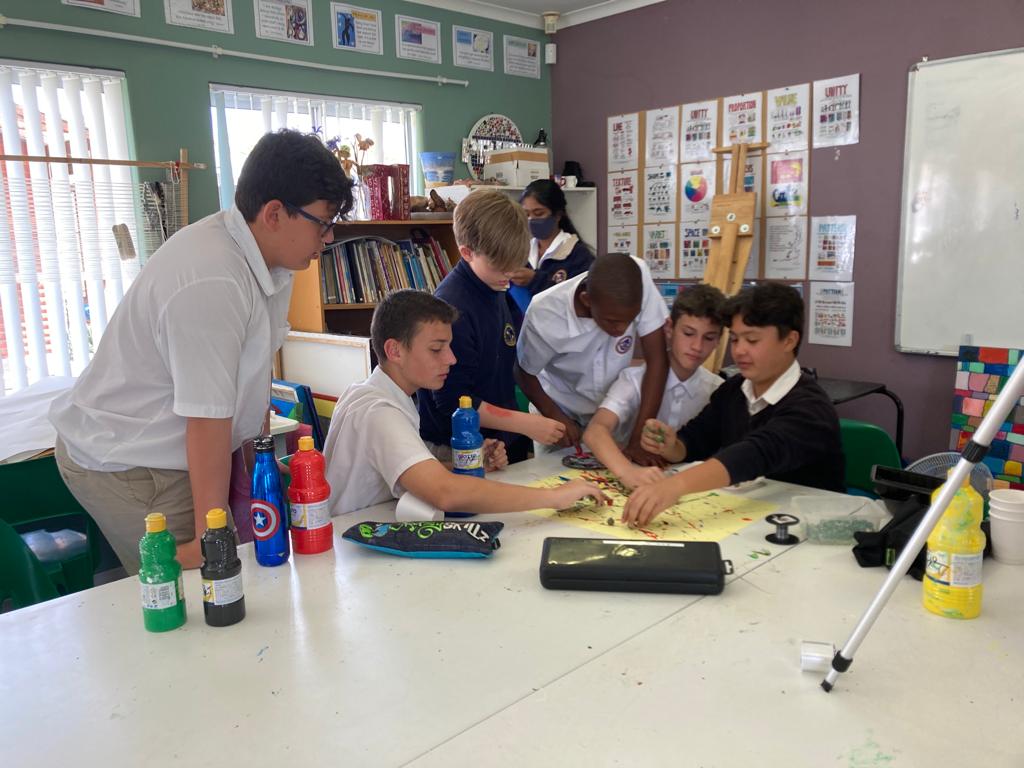
Our Year 7s spent the day in our High School today getting a feel for what awaits them in 2023! They had a number of different lessons throughout the day and thoroughly enjoyed joining the Art & Design class to create a Pendulum Painting using Science, Technology, Engineering, Art, and Math, inspired by the abstract painting of artist, Jackson Pollock. The lesson was a bit short to explore the project fully but a lot of fun (and mess) was had.
The class divided up into three groups. One group made use of a camera tripod, the other group supported a narrow plank of wood between two chairs to create the environment to set the pendulum in motion, whilst the third group experimented with paint dipped marbles which they rolled across the page to create yet another abstract piece. The activity experiments with the scientific principles of inertia and motion, using gravity and diluted tempera paints to make geometric patterns similar to a Spirograph.
So what is the Science behind this project? Sir Isaac Newton’s 1st Law of Motion –The velocity of an object will remain constant unless acted upon by an unbalanced force.
Isaac Newton was a scientist, mathematician and astronomer who was born in England in 1643. He is considered one of the most important scientists in history; even Albert Einstein said that Newton was the smartest person that ever lived.
Newton’s First Law of Motion (he came up with three) says that any object in motion will continue to move in the same direction and speed unless forces act on it. Simply, that means things cannot start, stop or change direction all by themselves. For example, if you kick a ball, it will fly forever unless some sort of forces act on it! As strange as this may sound, it’s true. But when you kick a ball, forces start to act on it immediately. These include resistance or friction from the air, which slows the ball down, and gravity, which pulls the ball down to the ground.
What is Inertia?
Inertia is the tendency of a body to resist a change in motion or rest. For example, when a vehicle stops, you tend to jerk forward before coming to a complete stop. In the same way, you will jerk backwards when the vehicle begins to move. This phenomenon is described by Newton’s First Law of Motion; objects tend to “keep on doing what they’re doing,” unless disturbed.
What is a Pendulum?
A pendulum is a fixed object, hung from a point so that it can swing freely back and forth due to the force of gravity. When the object is at its highest point, or furthest from the ground, it has maximum potential energy. When the object oscillates (swings) back and forth, it repeatedly converts its energy in motion due to the gravity on the swing.
How does all of this relate to the art of Pendulum Painting?
By adding paint to the pendulum in this project, one can demonstrate the science behind the Laws of Motion and inertia while making dramatic works of art. Though Jackson Pollock may never have used a pendulum to create his famous paintings, he did use the motion of his whole body to cover his large canvases with paint. One can observe the similarities and differences between the artworks created and the paintings of Jackson Pollock.
Sir Isaac Newton (1642-1727)
A pendulum works by converting energy back and forth, a bit like a roller coaster ride.
If there were no friction or drag (air resistance), a pendulum would keep moving forever.
About the Artist: Jackson Pollock
Jackson Pollock (January 28, 1912 – August 11, 1956) was an American painter and a major figure in the abstract expressionist movement. As a young boy, Pollock would explore Native American culture and Mexican muralist works while on land surveying trips with his father. This exposure played a major role in his earliest art influences. When he turned 18, Pollock moved to New York City to study art with his older brother Charles. During these studies, he adopted his rhythmic style of painting.
Pollock was widely praised for his ‘action painting’ — a technique that used the force of his entire body to pour, splash and fling liquid paint onto a horizontal surface. Hardened brushes, sticks and even basting syringes were used as paint applicators. Unlike traditional upright paintings, Pollock’s paint literally flowed from his chosen tool onto the canvas. With the ability to apply paint from all directions, he added new dimensions of movement to his works, which is why they were often described as unpredictable and undisciplined.
Our experiments and text were inspired by the Neuberger Museum of Art Education team.
Written by: Mrs Lynda Leibbrandt, High School Art Teacher