
MathsArt Competition 2022
Some of our Year 7-12 students are currently busy working on their entries for the local MathsArt Competition 2022 run by the GMMDC (Govan Mbeki Maths Development Centre Nelson Mandela University). The theme for this year is: “Mathematics: the language of the sciences”. This serves to link Art, Maths and Science (STEAM subjects) to address the question: “What do you get when you add MATHS and ART and the THEME and mix them up to the power of your CREATIVITY”?
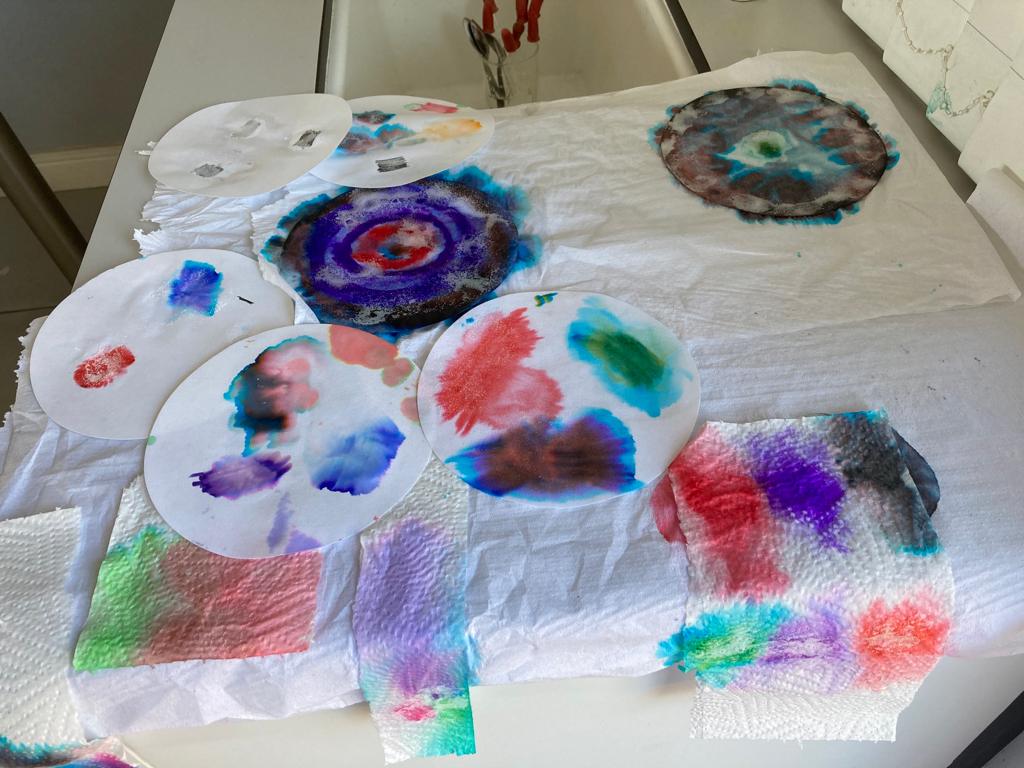
On the last day of Term 1, our Year 9 students together with their Sciences and Art & Design teachers explored some fun colour experiments to connect Art and Science by a series of simple paper chromatography experiments by looking at the components of black and coloured koki pens using: paper towel and/or filter paper and/or coffee filter paper, black and coloured kokis, plus different marker pens (permanent/non-permanent), water or vinegar and bicarbonate of soda, glass or tile bases, and pipettes.
In the first experiment black and coloured koki lines or designs were drawn on the paper towel, filter paper and coffee filter paper, with pipetted water droplets applied to the various papers so that the black and colours could diffuse. This resulted in students observing that black ink is simply not black but, along with the other colours, could separate into a rainbow of colours of differing lengths.
The same method was applied with the second experiment, however, bicarbonate of soda was sprinkled onto the black lines and coloured designs which resulted in a ‘fizzy’ chemical reaction when the vinegar was pipetted onto the bicarbonate of soda allowing colour mixing to occur.
So what really happened? Marker inks are made from many different coloured dyes. (This being the most obvious with dark colours like black and purple.) Each dye is made up of different chemicals, some heavier and some lighter, that travel at different speeds as the water moves them up the paper. Heavier dyes will separate out first and move more slowly whilst the lighter dyes move faster up the paper, creating a tie-dyed or washed-out effect. It is interesting to try and count how many different colours one can observe in the final product. The same activity can also be tried using Sharpies or other permanent pens and isopropyl alcohol instead of water. What happens? The water-based markers are water-soluble and can diffuse in water. The permanent markers are not water-soluble but are only alcohol soluble. The markers react and diffuse when vinegar is dropped onto bicarbonate of soda.
By performing this experiment the learners taking mathematics and Science observed the physical (cognitive) link between science and art and the art learners witnessed the link to Science. Mathematics and Science are subjects in which creativity is essential for problem solving, summarising and retaining theory and seeing the bigger picture.
This local MathsArt Competition is an amazing opportunity to bridge the gap between Art and Science and we look forward to more learners from the Science discipline participating next year! Thank you, Mrs Leibbrandt, for the opportunity!
Ms Amelia Burger and Mrs Lynda Leibbrandt
The Counselling Corner
Welcome to the Counselling Corner: A space where we will discuss all things mental health.
Reflections on our first PARENTING WORKSHOP
This week we had our first parenting workshop at Helderberg International School. We focused on the topic of SELF. We had a closer look at our childhood, our self-concept, and our parenting styles and its direct effect on our children. We also discussed the importance of self-care on our parenting practices and how we can support our own wellbeing in the midst of taking care of others.
For the parents who missed out on our first session, a summary of the topics we discussed:
My Childhood: Our unresolved childhood experiences affect our parenting, especially if we were raised in an environment where our childhood needs were not met (physical, psychological, social, and/or educational).
Childhood experiences that can cause struggles in our parenting practices include:
- Need for safety and belonging not met
- Loss of a parent/caregiver
- Abusive/neglectful parents
- No positive role models
- Raised by authoritarian or permissive parents
- Poverty/ socio-cultural turbulence
- Parental divorce/ discord
The above examples are only some of the experiences that can cause deep hurts within our psyche that we carry into adulthood, not realising the effects thereof on our emotional and behavioural responses towards our children. We thus bring our ‘unfinished business’ from our childhood experiences into our child rearing practices without being cognitively aware thereof.
This is where self-reflection becomes crucial. Self-reflection and the process of uncovering our core beliefs (the things that govern our behaviour) is a critical part of the process of becoming more effective, happier, and peaceful parents, and enables us to start the journey of healing our ‘inner child’ of the hurtful beliefs we adopted during childhood.
My Self-Concept: Building on the above foundation we explored the effects of our self-concept (ideal-self, self-image, and self-esteem) on our parenting. We focused on how our low self-esteem affects the development of our children’s self-concept and influences our ability to establish healthy relationships with them.
My Parenting Style: Thereafter we explored the different parenting styles and their effects on our children. A parenting style is the standard strategy that parents use in their child-rearing practices. We had to identify which style we make use of most and where we could make adjustments to our parenting style to support our children’s needs better.
Self-Care for Parents: Lastly, we delved into self-care and its vital importance to parenting. We explored the difference between ‘self-indulgence’ and ‘self-care’ and discussed the various ways in which we can take better care of ourselves (emotionally, socially, spiritually, and physically).
Thank you to the parents who joined the workshop and for your enthusiastic participation!
I hope to see you all in our next session together where we will cover topics such as:
- Understanding childhood development and speaking their ‘language’,
- Connecting with your child, and
- Building self-esteem in your child.
You are welcome to contact me with any enquiries, comments, or discussion topics you would like to see in The Counselling Corner.
Until next time, keep well!
Inge Smit
counselling@ingesmit.co.za
Irma Stern Museum
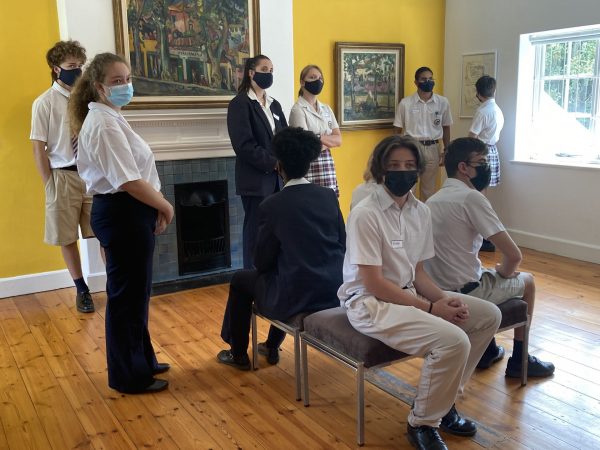
Early on Tuesday, 15 February, the our Year 10 and 11 Art and Literature High School students eagerly departed for a long awaited outing to the fascinating Irma Stern Museum at The Firs, in Cape Town.
The Curator, Educational Coordinator, Nombuko, had tables, chairs and umbrellas set up in the luscious green garden. The tour started with an introductory talk about the life and times of Irma Stern and her passion for the arts, mostly inspired by German Expressionism, her travels to exotic destinations in Africa and abroad and her eclectic collection of artefacts gathered over the years.
We visited each brightly coloured room which contrasted her paintings and art collections in a lively manner and listened to a brief history of the works housed in each section of the house, enabling the students to discuss her work, then fill in a worksheet, sketching and analysing their favourite inspirational artwork of choice.
After a short break we were fortunate enough to view the current exhibition Memórias da Madeira focusing on her time spent in the area. The students were invited to add their personal colour and mark making techniques with koki’s and pencils to a public group mural of an enlarged, black outlined version of one of her works which they participated in with great enthusiasm!
The next exciting project was the creation of a Remixed collage using colour copies of Irma’s artwork and other famous local and international artworks, pieces of newspaper, enhanced with oil pastel or koki if desired. There were some surprising and beautiful spontaneous artworks created in next to no time!
Students had the opportunity to wander around and picnic in the garden thereafter, then all too soon we embarked on the homebound journey to Somerset West. We learned a lot from Irma’s larger than life figure – her passion for the arts, sometimes suffering harsh criticism for her style of painting, her love of the exotic, travel and zest for life – always remaining true to herself.
Some inspirational quotes and reviews from our students follow:
Timeon, Year 11 Literature student writes…
“The day began ordinarily, but by the second period’s closure, we were long gone and off to the Irma Stern museum, where I realized that February 15th was the antithesis of ordinary. We arrived at a building that seemed too homely to be a museum. I later found out that the building had been Stern’s home for over forty years – no wonder the building where so many artworks were created inspired such a vivid feeling. That is what art is, no? The expression of vivid feeling through physical means.
Throughout the day, I gained a new appreciation for Stern and her works: the detail in her bushstrokes, the enduring colours and the emotion that came from the art. By the end of the day, we had all learnt something that would inspire the collages that were made. Each person created their own “remix” of Stern’s work that contained their own creativity. I may not be a visual art student, but Stern’s art still inspired me and it could inspire anyone else with an open mind. “
Lene, Year 11 Literature student adds:
“We started the day off as per usual – classes and such – and then the fun began.The building was a tan colour and also happened to be Irma Stern’s house. The inside, however had a mixture of bright neon colours on the walls with paintings and findings and sculptures in every direction you looked. Our guide used a calm relaxed tone and was quite knowledgeable on the paintings and different artefacts. Then came the activities: Firstly, we had to complete a worksheet where we were to describe an artwork. We then created our own art works, which consisted of using one of Stern’s works and combining it with other ‘art works’.All in all, it was a nice relaxing yet informative day out with class mates.”
Haadiya (Year 10) – What I found inspiring on my visit yesterday, was how unapologetic her artwork and life was. She was true to herself and expressed that freely in her paintings.
Zoey (Year 10) – I loved her scenic paintings and portraits, they were quite realistic but with her personal touch and you could kind of see how she felt while she was painting. It was nice to find out more about the artist herself and hear about her travels, the people she met along the way and to see her personal collection of objects she collected.
Isabell (Year 10) – I enjoyed getting to know more about the life of the artist and to see her different ways of painting. I could see that she was proud of her work and she did it in her own unique way.
Iminathi (Year 10) – I enjoyed seeing all the different artwork. The drawings and paintings were all unique but all expressed in the same way. I loved seeing how perfectly imperfect her work was because it taught me that I don’t have to be so cautious about my work and that it’s all about expressing yourself.
Connor (Year 11) – I really enjoyed the story of Irma Stern – getting to know the artist. I also really liked the way she used the different brush strokes and seeing all the beautiful paintings she made. I really loved how you could see that her work is really unapologetic.
Sidney (Year 11) – I liked the fact that she eventually didn’t care about other people’s opinion of her artwork and that she could turn anything into a great art piece like the flowers in a vase. I also like the colours that she used like the bright oranges and blues, with the hard brush marks visible at times. I loved the fact that she could paint still lives, portraits and create sculpture and pottery.
Ineke (Year 11) – I found quite a few artworks interesting, but I found one that I particularly liked because it reminded me of the Middle Ages artwork of dancing skeletons from the Danse Macabre. I liked the composition, poses, colour and the voluptuous women contrasted with the skinny skeletons that she painted on one of the doors in her studio. The music playing in the room also added to the atmosphere.
Keenan (Year 11) – The Irma Stern outing was a truly eye-opening experience for me,it made me completely rethink how I do art.It helped me realize that art is not being as perfectly identical and correct, but should be a reflection of the artist’s uniqueness, which Irma is mastered in.
Sino (Year 12) – What I found most inspiring is how Irma Stern’s artwork had a lot of African background to it and the way she used oil paint to capture many details on clothing, buildings and facial features but mostly the bright colours contrasted with the dull colours on her other paintings.
Sam (Year 12)- I found her Zanzibar door very inspiring.
Arnoux (Year 12) – For me, the most inspiring thing was how the paintings did not follow conventional painting techniques for the time. It takes a lot to be different, which I respect.
Read More
From the Principal’s Desk – 19 August 2021
Dear Parents
Do you throw that old cereal box, margarine tub or jam jar into the rubbish bin? Don’t let one of our Eco-warriors see you!
Our precious Year 3s take their chosen responsibility of protecting Mother Earth very seriously indeed. Not only have they worked tirelessly on the recycling campaign, but they have also taken it upon themselves to ensure that the whole school understands the severity of the problem and the benefits that small gestures can have for everyone.
They took the time to address not only the foundation phase, but also – very bravely – the Primary and High school students during their assemblies. I have not heard that enthusiastic an applause from the High school in some time!
These young students, brim-full of energy, dedication and determination, are an example to us all. Choose one cause (there are so many to choose from), apply yourself rigorously and make small changes that will result in a big impact when repeated consistently. And that, ladies and gentlemen, boys and girls, is how you change the world. You, too, can make a difference with not too much effort.
Our recycling bin will be arriving on campus within the next week or two and we would like to extend an invitation to our whole community to contribute to the cause by adding your paper waste to our bin. Not only will you make a difference to our environment, but you will also contribute to the funds raised with every bin filled with paper.
Mrs Moyes has certainly earned every day of her maternity leave this term! With her last day dawning tomorrow, we wish her all the best as she and her family prepare to welcome a new little person into the fold. May their days be filled with joy and wonder as the family celebrate the miracle of life and growth. The Year 3 students will thus be welcoming Mrs Mary Farmer back after having met her earlier in the week. We know that Mrs Farmer will do a great job given her many years of experience and, together with the Year 3s, we are excited for the opportunities that a new teacher brings to the classroom.
Another new development at HIS is the appointment of a new High School Coordinator. Congratulations to Mrs Nicci Geyer on the appointment. We have no doubt that she will guide the High School efficiently and with compassion. Should you have any high school related queries, please feel free to email her at nicci.geyer@iesmail.com.
Please remember tonight’s Elevate course for parents at 18h00, and the student workshops being held tomorrow at school. These have proven to be extremely valuable to both parents and students and we encourage to attend if possible. Please do let us know if your child will be attending online.
It has been wonderful welcoming more of our students back this week. I watched in wonder and joy as a group of teens ran around the field chasing each other laughing yesterday and was reminded that happiness is to be found in the little things – fresh air, friends and freedom. Walking home in the evening with the opportunity to greet passers-by, smell the jasmine heralding the coming of Spring and hearing birds acknowledging that this is so.
Wishing you all a weekend full of joyful little things.
Ms Cristina Sanchez Black
Principal
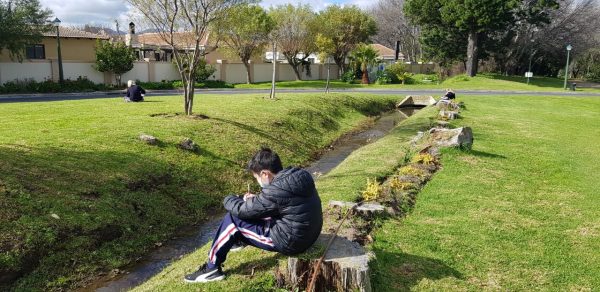
Year 6 – Nature’s Art
Our Year 6 class spent time learning about the British artist, Andy Goldsworth. He is a British artist known for his installations involving natural materials and the passage of time. Andy owes his love towards nature to his family, who introduced him to agriculture at a very tender age. Since then, he had the idea of creating sculptures using already existing elements of nature. He is a meticulous sculptor producing site-specific land art situated in natural and uban settings.
The Year 6 class took advantage of the beautiful sunny winter weather and we went outside to explore nature’s art. They looked at details, colour, patterns and freedom. Even the online students went on the Art walk with their class.
Read More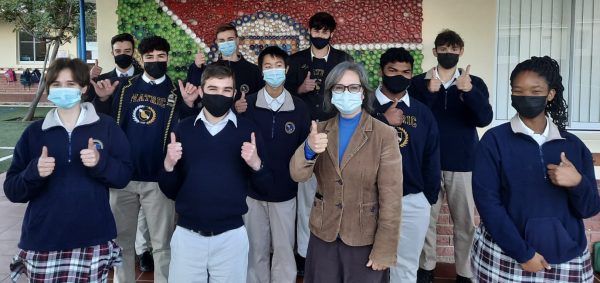
From the Principal’s Desk – 13 August 2021
Dear Parents
We are thrilled to announce that our latest exam series has been one of our most successful to date after receiving our students’ results this week.
Our IGCSE students achieved the following:
An astounding 20 A* symbols,
14 A symbols,
7 B symbols, and
14 C symbols.
Equally pleasing are the A symbols achieved by two of our AS candidates, who wrote off the AS component of their subjects earlier than usual.
A hearty congratulations to all of our students (pictured above, as well as those who are online from home). We are so very proud of the hard work that these results represent and of the growth that you have all shown as students. I’d also like to congratulate our High School teachers who have guided these young people to the successful completion of and, indeed, excellence in their subjects.
Receiving exam results naturally leads one to ponder the nature of progress, development and growth, a topic that has been on my mind lately as we sand, chip and grumble our way through some DIY renovations at home. With each new discovery of a loose patch on the wall or yet another damp area, the challenge can seem overwhelming. And after a long weekend of finger-numbing and back-aching scraping amongst the swirls of fine dust that settles everywhere, it looks like you have achieved very little.
The fact is though, that as I lay my weary head on my pillow, a deep sense of accomplishment and satisfaction envelops me and I realise that good progress has been made; that in order to make progress or develop, one often needs to digress or take a few steps back to correct something; that in order to improve, one needs to be totally immersed in the task at hand. There is no other way.
This holds true for our students too. Those who aspire to grow and develop their potential, engage fully in their lessons, immerse themselves in their subjects when doing their homework and ensure that they have got to the very core of a topic in order to understand it fully. Just slapping on a coat of paint over a bad patch, or quickly rushing off a task to say that it has been completed achieves nothing.
It would seem to me that our Year 11 students in particular have learned this valuable life lesson and know how to approach their learning and development with intent and pride. They have taken ownership of their own growth. It’s a simple life truth really: what you put in, is what you will get out.
Of course, this philosophy can be taken further to include other aspects of life. How we approach the limited and restrictive life we are forced to lead now, determines what the future holds. Let’s put in patience, understanding and self-care; let’s be respectful of others’ well-being and perspectives; let’s not drop our guard.
Please take note that the second Elevate workshop will be held next Friday, 20 August, at school. Students who are still attending class online are encouraged to attend the workshop in person, however, it will be online should any of the participants be at home for any reason.
This term we are hoping to have some fun with our teens as the High School hosts a Cultural Bonanza. Please encourage your teens to participate. We know that our students are very talented and celebrating one another’s skills while having some fun is just the kind of event that we all need at the end of the term.
As the second half of August approaches and we enter the fifth week of the term, effectively having passed the mid-term mark, you are requested to fill in a google form once more, indicating whether you will be sending your child to school from the 16th or not. This will help us to plan and prepare the classes accordingly. Online classes will continue to be available for those who prefer to keep their children at home for now, however, we would like to suggest that it would be best to send Foundation Phase children to school as soon as possible. We also ask that you please ensure that your children understand the need to comply with the health and safety protocols that the school is required to maintain. Please take some time to speak to them about the need for social distancing and clean face masks that are worn correctly.
We look forward to welcoming more of our students back next week. Take care and stay safe. Wishing you all our families a good weekend.
Cristina Sanchez Black
Principal
From the Principal’s Desk – 30 July 2021
Dear Parents
What a wonderful week it has been having some of our students back on campus! It has been a week filled with the simple pleasures of eager, curious eyes, happy chatter, spontaneous laughter and active teaching. Despite the third wave, Helderberg International has not skipped a beat and our students are on track with their learning for the year. How very blessed we are! And how very blessed we are as teachers to serve our community. Having said that, we think of those in our community who have lost loved ones due to the pandemic. You are in hearts and thoughts.
Margaret Mead (1901 – 1978), the anthropologist, was once asked by a student what she considered to be the first sign of civilization in a culture. The student expected Mead to talk about fishhooks or clay pots or grinding stones.
Instead, Mead said that the first sign of civilization in an ancient culture was a femur that had been broken but had healed. She explained that if an animal breaks its leg, it dies. It cannot run from danger, cannot get to a river to drink, nor can it hunt. It becomes prey. No animal survives a broken leg long enough for the bone to heal.
A broken femur that has healed is evidence that someone has taken the time to stay with the one who is injured, has bound up the wound, has carried the person to safety, and has tended the person through recovery. According to Mead, helping someone else through difficulty – serving others – is where civilization starts.
It gives me great pleasure to witness, every school day, myriad small acts of service within our civilized community. From the courteous year 4 boy who insists that I pass through the door first, to the jovial caretaker who elicits a smile from everyone he passes, we all contribute to the well-being of the HIS family. Sadly, a member of the family will be leaving us after more than 17 years of dedication and tireless service. Minkie, we thank you for your contribution to our school over so many years and wish you every happiness as you begin this new chapter of your life. We also say goodbye this week to Teacher Danni who has made an impact in such a short time with her cheerful spirit and willingness to help as she jets off to the USA to complete her studies. We have no doubt that she will make a great teacher. Go well, Danni – there are some very lucky children waiting to become your students!
Today happens to be International Friendship Day. Proclaimed by the UN in 2011, the idea is behind this celebration is that friendship between people, cultures and countries has the power to inspire peace and build bridges between communities – an idea that aligns perfectly with the IES vision. There is no better time to celebrate those close to us, and show gratitude and support for our peers, friends, family and staff. Wishing you all a happy Friday and a blessed weekend.
Ms Sanchez Black
Principal
From the Principal’s Desk – 24 June 2021
Dear Parents
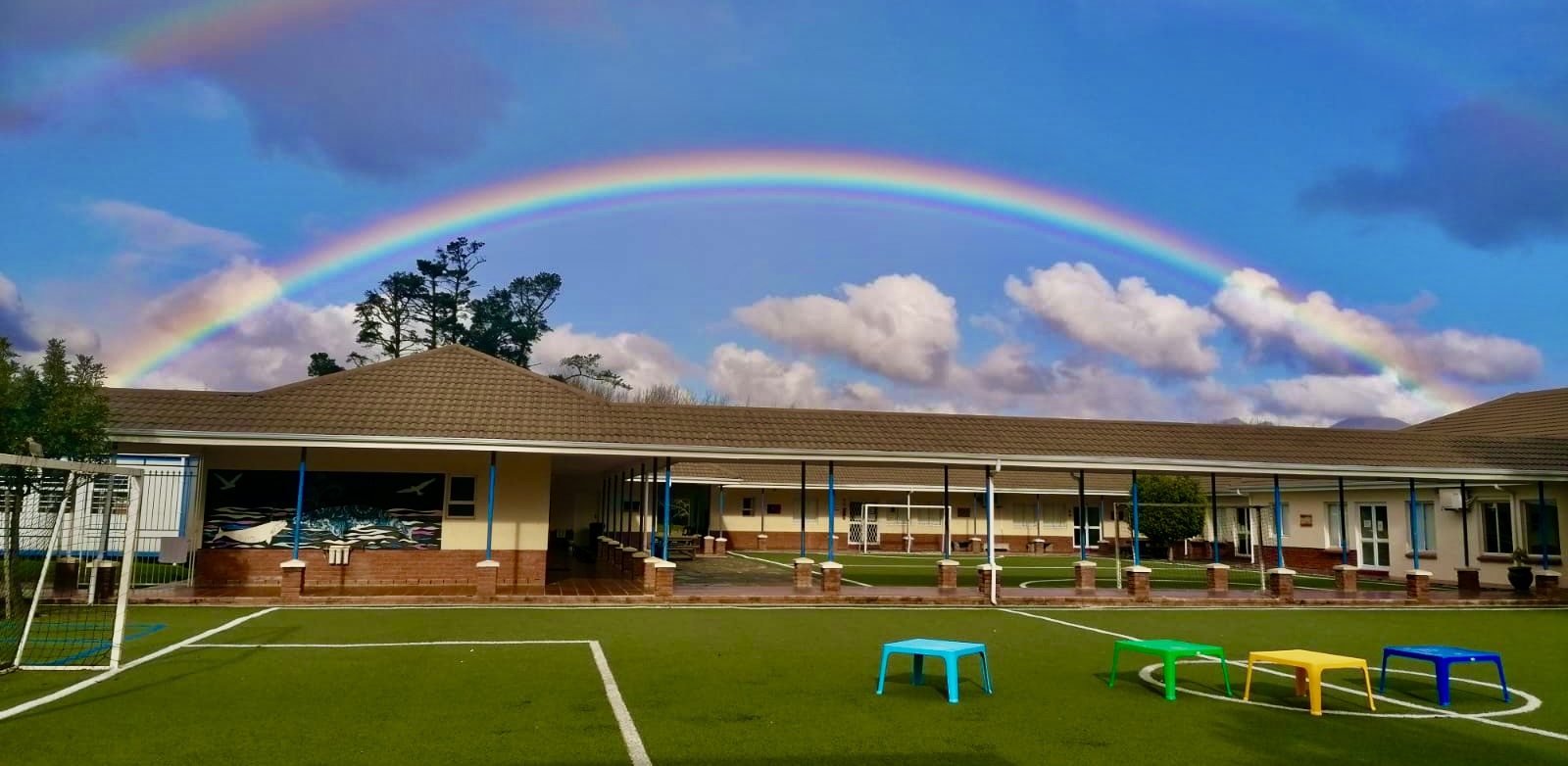
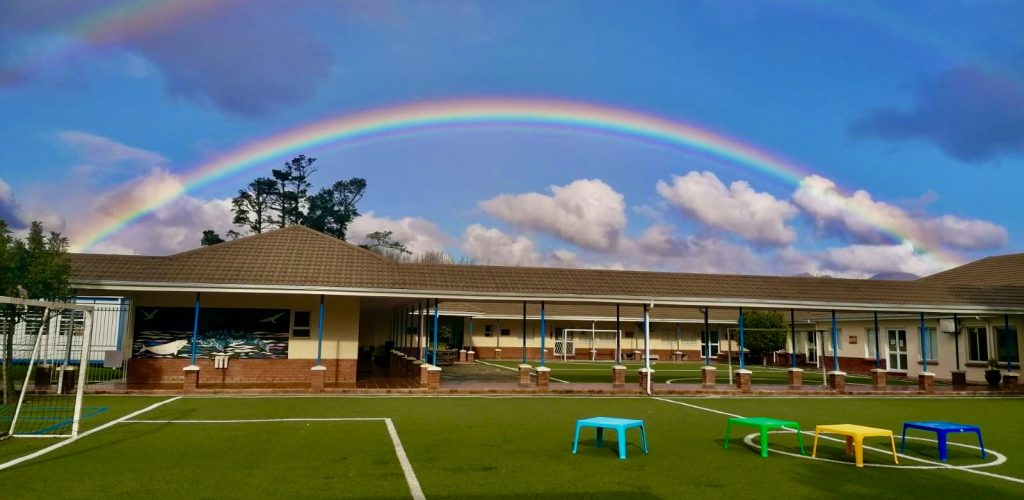
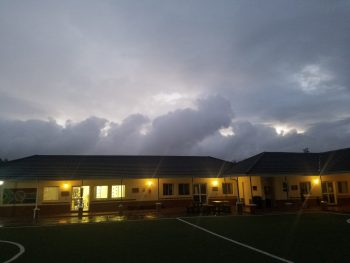
In my last newsletter for the term I would like to refer to the photo above. The sun rises on a new day despite an intimidating bank of clouds that crowd over the school’s roof threatening to swamp it with their burgeoning mass. Above the mounting muscle, to the right, a vortex is visible, possibly bringing rain and adding to the sense of gloom and impending hardship.
And yet, if you look carefully, you’ll notice signs of hope. In the foreground, our little school stands strong and welcoming, Miss De Freitas’ door open and ready to draw in the first students to arrive at school. Pools of light warm the surface of the play area directly in front of the class, while a chorus line of wall lights throws its arms open invitingly to include all and sundry. Behind the clouds, daylight approaches. A new day is coming with all the promise that it holds. There is nothing to fear. The clouds will prove impotent, the vortex, an illusion and the gloominess will dissipate like so much moisture in the air.
Some storms are like that: all thunder and no rain. The storm we face as we prepare to go on winter break, is not one of those. It requires more of us than to merely put on the lights and open the door. I know: we are battle weary. We may feel that we do not want to put up with this anymore. We may wish to throw caution to the wind, come what may.
The truth is, though, that we are either part of the solution or part of the problem; either preventing or contributing to the rise in infections. There will be no reason to fear the onslaught of the third wave if we play our part. Stay home (without Uncle Cyril forcing you to do so), avoid social interaction as much as possible and do all you can to ensure that you do not contribute to spreading the virus.
After a busy term, there is no better time to withdraw and use the time to regroup. Reconnect with your family. More than ever, your children need to hear the stories of your childhood. They need to find the joy in the little things – we all do! Build a puzzle together as a family; cook together; learn a new craft as a family. Teach your children to dance. Teach them about light, about new days and about hope. Stay home together and stay safe.
Also in the newsletter today is a well-written essay by Vincent Arnaud in Year 12 on excellence, one of the School’s values. It is truly heart-warming to know that we have students of this calibre at HIS.
Sadly, this term we say goodbye to two excellent teachers. Dr Alan Meyer is off on an adventure to teach in the Middle East, while Mrs Reynolds and her husband will be furthering their studies in the Netherlands. We would like to thank them for their contribution to our school and wish them both the very best in this new chapter in their lives. In their place we welcome Ms Amelia Burger, who will be teaching Chemistry and Physics to the seniors and Mr Tiaan Bothma, who will be taking the position of Music teacher. We would like to welcome them to the HIS family and hope that they will be very happy with us.
Before school resumes for the third term, a decision regarding online classes will be made based on the national and local Covid situation and in consultation with our sister schools and the board. This will be communicated to you in the week of 12 to 16 July. Be assured that our priority remains the well-being of our community and we will not hesitate to begin the term online should this be necessary.
We wish all our students, parents and teachers a well-deserved break.
Ms Cris Sanchez Black
Principal
“Excellence” is the most important school value, and also the most ubiquitous
Please have a read this wonderful Argumentative / Discursive Essay essay written by one of our Year 11 students, Vincent Arnaud. It is on the School’s core values, notably Excellence, and especially at exam time this may be very appropriate.
“Excellence” is the most important school value, and also the most ubiquitous
At the International School of Helderberg, there are seven values which are touted as being crucial to good living and learning practices. These values are Pride, Integrity, Empathy, Excellence, Accountability and Respect.
Pride is taken to mean a reasonable degree of self-respect and the acknowledgement of one’s own achievements. It is not to be confused with arrogance or conceit. Integrity is defined by the Merriam-Webster dictionary as being a firm adherence to a code of especially moral or artistic values. It is closely linked to Accountability, the quality or state of being accountable or the practice of holding oneself responsible for one’s thoughts, words and actions. Empathy is the practice of taking other people’s feelings or points of view into account, whether you are or are not in support of their ideas, in an effort to be as constructive and helpful as possible and to minimise needless negativity and callous cruelty. Respect is defined as the act of giving particular attention to something or holding it in high regard. At our school, most people seem to use the word as a way to describe a combination of etiquette, kindness and the preservation of other peoples’ dignity. The Merriam-Webster dictionary defines Excellence as the quality of being excellent(eminently good), and connotes the word to virtue.
I am of the opinion that Excellence is a quality which, by virtue of being inclusive of all others, is the most important to remember and to strive towards.
Firstly, Excellence and Pride are mutually inclusive qualities: if Pride is a justified respect for yourself or the work you create, then Excellence is the standard to which you aspire. To achieve Pride you must first achieve Excellence. Virtue, a word which is semantically similar to Excellence, connotes a quality or trait which is deserving of merit, meaning that Excellence is something to be earned – just like our school’s definition of Pride.
Integrity implies a certain firmness of belief and an adherence to chosen behaviours, usually positive ones. It is an excellent quality to have, as it informs the manner in which we view and treat others and ourselves, and influences the ways in which we will approach tasks.
In pop-culture, specifically the Bill and Ted franchise of movies and television series, the word ‘excellent’ is sometimes used to describe a way of treating one’s fellow person: “be excellent to each other” is one of the duo’s most memorable quotes. In the very nonchalant and oft-immature language of the characters, this would mean to treat others with Integrity, with Respect and with Empathy. I believe that there are many people, especially Americans who were children or teenagers in the 1980s, who knowingly or subconsciously use the word Excellent in this way due to this influence, and that it would be justifiable to canonise this definition of the word by adding it to the English dictionary. I mean – they added ‘lol’ in 2011, and pneumonoultramicroscopicsilicovolcanoconiosis (I typed that perfectly first try) is still in the dictionary, despite just being a synonym of the word silicosis, but specific to volcanos.
Because of this additional way of defining the word, Excellence can be used to stand in for at least three of our school’s values with a minimal need to explain its inclusion.
But what should Excellence mean to you? How can you practice Excellence in your life, in and outside of school? I will share my answer to this question by explaining the ways in which I behave which I believe are Excellent, and also some of the things I would like to change in order to be more Excellent.
One of the main ways in which I try to let Excellence dictate my decisions is in my efforts to keep all of my friendships emotionally open and trust-based. I try to be available for people when they are struggling, because I understand how it feels to have no one available and ready to listen or offer advice and support.
Another way in which I strive for Excellence is the effort I put into my subjects at school, even subjects which I don’t enjoy. I am of the mindset that I will benefit from doing well in my studies consistently in the event that the unforeseen occurs and I underachieve for reasons which I could not have countered, for instance having to take time off being sick for a long time and falling far behind.
One of the ways in which I am lacking Excellent behaviour is in my conflict resolution skills. When disputes arise I am often described as being condescending, stubborn or aggressive. Although this is often unintentional, I can often recognise that the criticism is a valid one, and I would like to avoid this sort of behaviour in the future.
I hope that I have demonstrated both the ubiquity and the importance of the value of Excellence, and proven to you that it is the most important school value.
Written by: Vincent Arnaud, Helderberg International School
From the Principal’s Desk – 18 June 2021
Dear Parents
When I think about our school, I invariably feel a warm glow inside and a smile appears involuntarily. In my head, the soundtrack begins… “In my little red schoolhouse, with my book and slate.” Warm memories of Aunty Greta teaching the song to three eager ten-year-olds flood back. I hear happy sounds: children’s animated chatter, laughter, a bell ringing. It happens every time. Romantic? Definitely. Soppy? Perhaps. But the truth is that this is how I perceive our school. It is a happy place that fills me with joy.
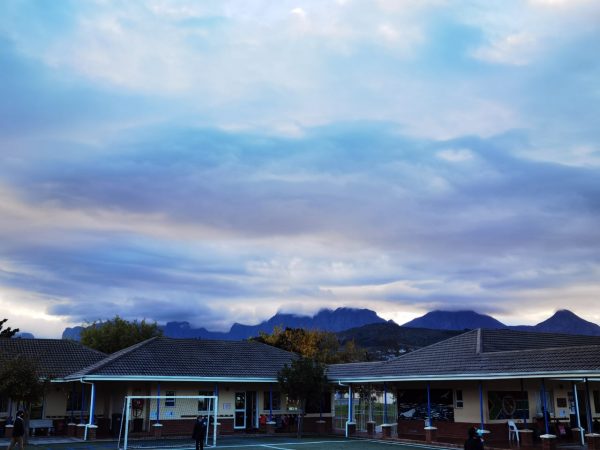
Is it the building? Well, no. Although I do love the quad and the fact that, for the most part, we can all see each other at a glance. Is it the site then? No, it’s not that either. You already know that I love the row of trees outside the school. The pretty new beds in the front are pleasing too, as is the protective mountain that enfolds the School in its embrace, but no, it is none of those things.
What brings me such joy is our community. American author, Coretta Scott King, said: “The greatness of a community is most accurately measured by the compassionate actions of its members.” And that is the secret to the joy to be found at HIS.
There is warmth in this community; there is heart; there is compassion. From the youngest cherubs, who showed their appreciation to various staff members last week with a small gesture, to the Year 3 students who want to make a difference in the world by planning, presenting and putting into action a recycling system all on their own, to our veteran volunteer, Granny Beth, who helps out in the library, our community members have heart. From the teachers who tirelessly (and selflessly) give day after day, to our supportive parents who drop off and then pick up again, attend meetings, make contact, cover books, screen students in the mornings, provide care packages to unwell members of staff and more. Are we not abundantly blessed?!
In these difficult times, I believe that it is this very sense of community that will carry us through. “Alone, we can do so little; together, we can do so much,” said Helen Keller, while Margaret J. Wheatley, recipient of a Lifetime Achievement Award from the International Leadership Association, is of the opinion that “there is no power for change greater than a community discovering what it cares about.”
At Helderberg, we care for our community. As an international school, that care extends far beyond the borders of our school grounds and encompasses the greater community at large. When all hope seems lost, we lean on each other and, together, we move forward. As Margaret J. Wheatley put it: “Hopelessness has surprised me with patience.” And so we learn to be patient; we learn to support; and we learn to be carried. All valuable life-lessons.
The third wave beckons. Let us take courage from one another, holding on tightly to that which we care about and that which gives us our strength. Together, we can patiently say, “This too shall pass.”
Take Care.
Cristina Sanchez Black
Principal